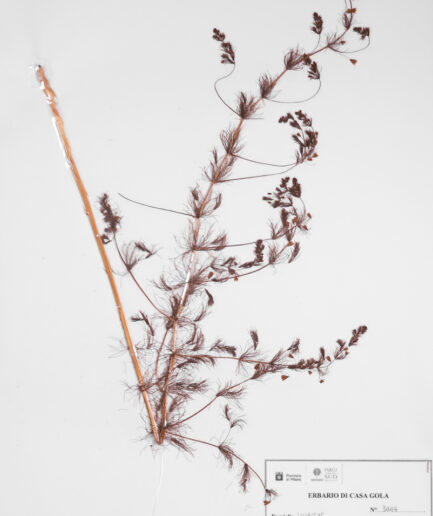



Virginia creeper
Scientific Name: Parthenocissus quinquefolia (L.) Planch.
Family: Vitaceae
MORPHOLOGY
Habit and dimensions: shrubby plant with a climbing or creeping habit, reaching lengths of 1-6(30) m.
Stem: trunk with reddish-brown bark that peels with age (ritidomia).
Leaves: deciduous, palmately compound, glabrous, alternate, with long petioles at the nodes, initially dull green and then turning crimson after the summer period; leaf blade is completely divided into (3)- 5(7) lanceolate-obovate segments, the largest being 12 x 2 – 6 cm, the lateral ones smaller and asymmetric, with sharp teeth along the margin. Opposite the leaves are the characteristic tendrils, consisting of filaments with (3)5 – 8(12) ramuli and an adhesive disc at the terminal end.
Flowers: the inflorescence is more or less hemispherical and thyrsoid (compound), inserted towards the middle of the stem and at the nodes. Flowers are inconspicuous, hermaphroditic, with 5 greenish petals (3 mm). Blooms from May to June.
Fruits and seeds: berries with 1-2 seeds.
DISTRIBUTION AND HABITAT
An invasive allochthonous species present throughout Italy except Molise, on walls, ruins, and scrublands between 0 and 800 (1,000) m.
USE
North American Indigenous peoples attribute laxative, anti-inflammatory, urinary tract soothing, emetic, and expectorant properties to the young leaflets. The fruits are toxic. Before taking any plant-derived product (medicinal or non-medicinal) for therapeutic or similar purposes, it is always advisable to consult a physician.
INTERESTING FACTS
The plant always needs to lean on a supporting structure, which is why it is used as a climber to cover walls, structures, gazebos, fences, or pergolas. When naturalized and not limited by human intervention, it becomes invasive and burdens trees, making life difficult for native climbers.
Photo: licensed freely by iNaturalist and by Saxifraga and Rutger Barendse