


Dove’s-foot Cranesbill
Scientific name: Geranium molle L.
Family: Geraniaceae
MORPHOLOGY
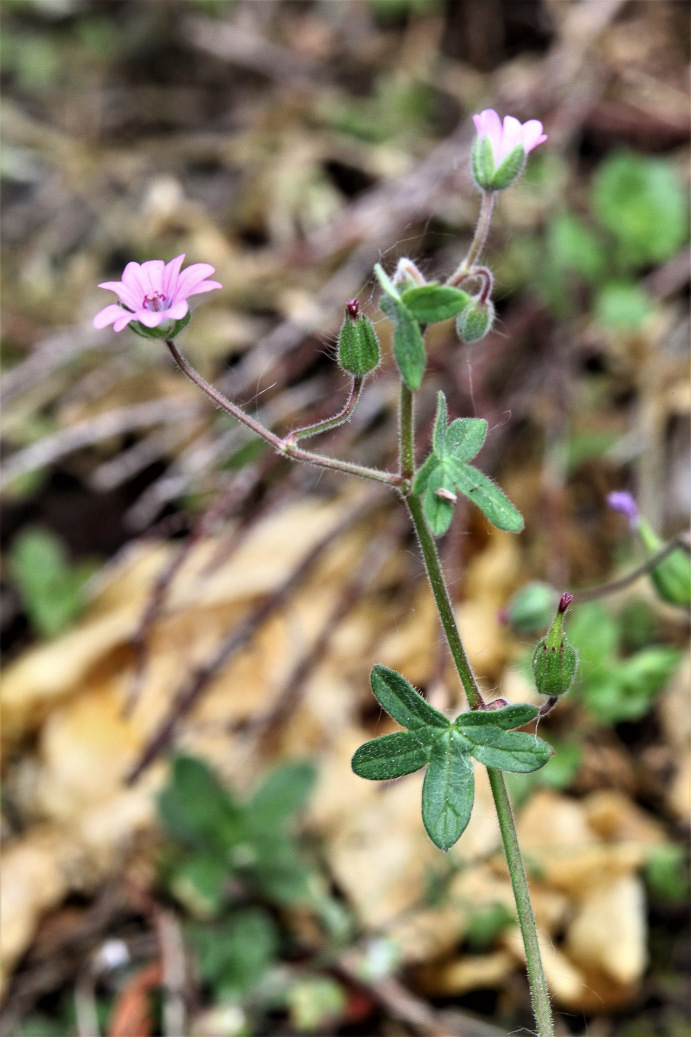
Growth habit and size: Annual or biennial herbaceous plant with a loosely fasciculate root system, usually hairy and soft due to simple hairs, up to about 2 mm long or shorter glandular hairs. Height 5÷40 cm.
Stem: Slender, ascending or erect, grooved and reddish with deflexed hairs.
Leaves: Basal leaves in a persistent rosette, long-petiolate 5÷14 cm, with an orbicular or reniform outline, divided into 3 segments, each further divided into three lobes; cauline leaves, generally alternate, are smaller in size and have progressively reduced petioles.
Flowers: Two-flowered cymes with a peduncle bearing a whorl of small, villous, sub-erect, lanceolate bracts at the base of the branching pedicels of each flower. The calyx is persistent with 5 free, lanceolate, hairy sepals with a scarious margin and a short apical mucro, generally reddish. The corolla, ranging from pink to violet, is composed of 5 obcordate petals usually 5-6 mm long, erect-patent and glabrous on at least the upper surface, with 5 darker, divergent veins, emarginate at the apex or bilobed. It blooms from February to September.
Fruits and seeds: The fruits are schizocarps with a hairy beak due to erect-patent hairs, which at maturity divide into 5 glabrous and brownish mericarps, with prominent transverse ribs.
DISTRIBUTION AND HABITAT
This plant grows throughout Italy. It thrives in dry and sandy meadows, vineyards, fallow fields, and arid environments, from sea level up to 1,000 m.
USE
It is an astringent, vulnerary, and pain-relieving plant; it is recommended for treating dandruff. Before taking any plant-based product (medicinal or non-medicinal) for therapeutic or similar purposes, it is always advisable to consult a doctor.
Photo: Kindly provided by Claudio Farinati