


Ramsons
Scientific Name: Allium ursinum L.
Family: Amaryllidaceae
MORPHOLOGY
Growth habit and size: Perennial plant, 20-40 cm tall, with a slender oblong bulb surrounded by entire whitish membranous tunics.
Stem: Angularly semi-cylindrical stem.
Leaves: Generally, 2 basal leaves, oval-lanceolate, 10-20 cm long and 3-6 cm wide, with a long winged petiole, 5-15 cm long, bright green, emitting a strong garlic odor when crushed.
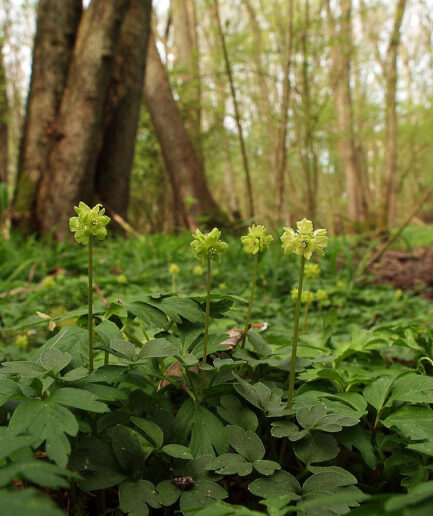
Flowers: Inflorescence at the top of the scape, gathering in umbels of 6-20 flowers, irregularly subspherical, 3-6 cm in diameter. Before flowering, they are enclosed by a papery spathe, entire or divided into 2-3 lobes, caducous, not exceeding the size of the umbel. The flowers consist of 6 white lanceolate tepals, about 1 cm long, longer than the stamens, with a peduncle up to 2 cm long. It blooms from April to June.
Fruits and seeds: Trilocular capsules that open longitudinally, releasing the seeds.
DISTRIBUTION AND HABITAT
It grows throughout Italy except in Sardinia from sea level to 1,500 m. It spreads mainly in deciduous forests, shady and humid places, and particularly in moist valleys in numerous colonies on fertile and humus-rich soils.
USE
The properties of ramsons are practically the same as common garlic (A. sativum) and it is mainly known as an anthelmintic, but it is also a good diuretic, gastric stimulant, antiseptic, cholagogue (i.e., it acts on bile), and an effective blood detoxifier. Fresh leaves on the skin have rubefacient properties and, when used as a poultice, they soothe abscesses and boils. In the culinary field, during the spring season, the tender leaves, finely chopped, are recommended to season salads or flavor butter, and to give a delicate and pleasant flavor to meats, not as strong as other garlics. They are also used to flavor potatoes, chicory, eggs, soups, broths, adding them at the last moment to fully appreciate their aroma. In cooking, the bulb can replace A. sativum. In Slovenia, an oil based on ramson leaves is produced and used as a seasoning on boiled potatoes, toasted bread, pasta, and especially recommended for flavoring fish dishes such as mackerel or cod. The preparation somewhat resembles Genoese pesto and is composed of about 40% finely chopped ramson leaves, a handful of chopped almonds, salt, and pepper as needed, well covered with extra virgin olive oil. Before taking any plant-based product (medicinal or non-medicinal) for therapeutic or similar purposes, it is always advisable to consult a doctor.
INTERESTING FACTS
The leaves of A. ursinum can be confused with those of Convallaria majalis L. (lily of the valley, a toxic plant) when the plants are not yet in bloom, but the ramson leaves, when crushed, emit a strong garlic odor that makes them unmistakable. Allium ursinum and Allium victorialis (rarer, found in higher mountain areas) are the only garlic species to have large lanceolate leaves, unlike others which have long, narrow leaves.
RECIPES
Ramsons pesto: Finely chop or blend tender ramson leaves, almond flour (or peeled almonds), and grated Grana or Parmesan cheese, all in equal parts. Add extra virgin olive oil until you get a slightly creamy mixture. Excellent for seasoning dry pasta (possibly with the addition of diced cherry tomatoes sautéed briskly in a pan with a little chili pepper) or on toasted bread slices.
Photo: Kindly provided by Claudio Farinati