


Common Crosswort
Scientific name: Cruciata laevipes Opiz
Family: Rubiaceae
MORPHOLOGY
Growth habit and size: Perennial herbaceous plant, 10-60 cm tall.
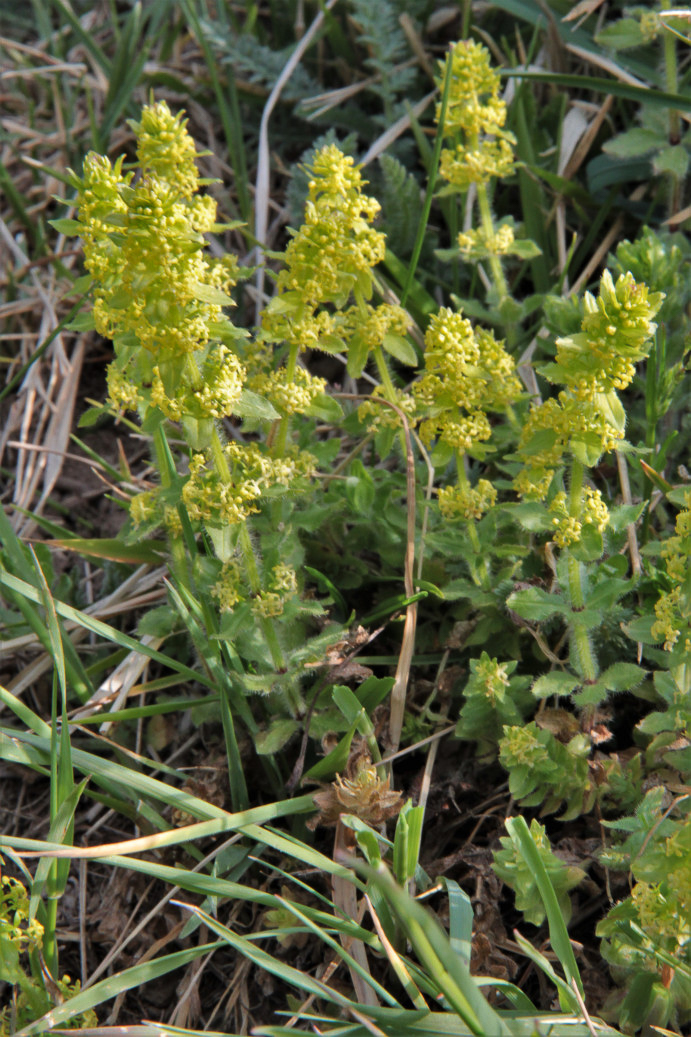
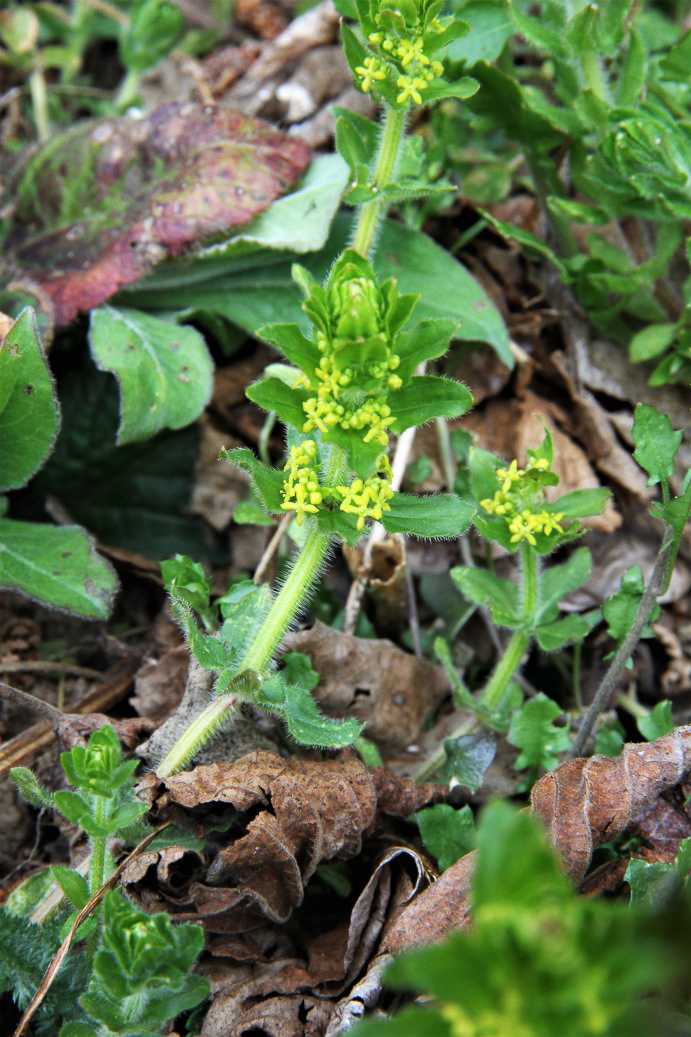
Stem: Ascending stems, rooting at the base, quadrangular, usually with dense white spreading hairs, 1-2 mm long, without thorns, sometimes reddish; longer internodes in the upper part, 4-8.5 mm long.
Leaves: Whorled in groups of 4, three-veined, lanceolate, or ovate (4-10×12-20 mm), lower leaves generally reflexed, floral leaves are yellowish green.
Flowers: Inflorescence in 5-9 flowered cymes with 2 bracteoles smaller than the axillary leaves. Corolla with 4 shortly acuminate oval lobes, yellowish green, 2-3 mm diameter. Calyx absent. Flowers (5-11) tetramerous, actinomorphic, gamopetalous, central flowers hermaphrodite, lateral flowers male, on hirsute peduncles. It blooms from March to July.
Fruits and seeds: The fruit is a schizocarp of 2.5-2.8 mm, with 1-2 subglobose mericarps, glabrous and smooth or slightly striated, brown olive, turns blackish and shiny.
DISTRIBUTION AND HABITAT
It grows throughout Italy, from sea level up to 1,500 m. It thrives in uncultivated areas, roadsides, and forest margins.
USE
It has astringent, diuretic, and vulnerary properties. In the past, it was used to soothe wounds, and its leaves were used to make a wine-based decoction to stimulate appetite and relieve stomach and intestinal obstructions. Before taking any plant-based product (medicinal or non-medicinal) for therapeutic or similar purposes, it is always advisable to consult a doctor. A red dye can be obtained from its roots.
Photo: Kindly provided by Claudio Farinati