

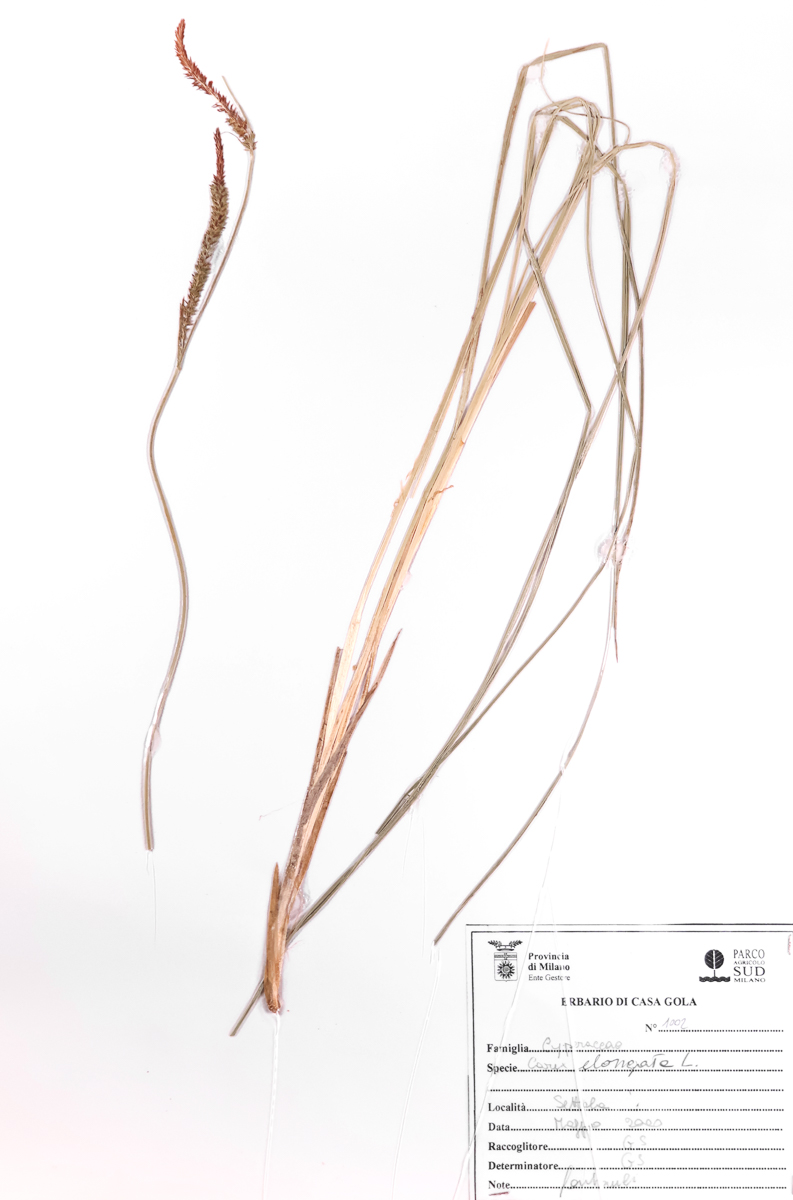


Elongated sedge
Scientific name: Carex elongata L.
Family: Cyperaceae
MORPHOLOGY
Habit and size: Perennial herbaceous plant, 30-60 (80) cm tall, with short rhizomes and densely tufted.
Stem: Sharply trigonous stem, about 1 mm in diameter, rough. Basal sheaths are light brown or pinkish-brown, glossy, persistent, with a concave apex.
Leaves: Leaves are 2-5 (6) mm wide, soft, rough on the lower surface, about as long as the stem.
Flowers: Inflorescence is narrow, 4-10 cm long, consisting of (6) 7-11 (15) androgynous spikes, (5) 8-15 mm long, cylindrically club-shaped with lower male flowers and upper female flowers, sometimes all lower spikes are entirely female, rarely a top spike is entirely male. Male glume is 2.5-3 mm, ovate-oblong, light reddish-brown with a green median vein and wide hyaline margin, rounded or obtuse apex ± mucronate; female glume is about 2 mm, ovate-elliptic, reddish-brown with a green central vein, acute or obtuse apex. Blooms between April and June.
Fruits and seeds: The fruits are pseudanthia (utricle) 3-3.5 (4) x 1 mm, glabrous, green, elliptical-lanceolate, often curved, with 6-10 well-defined nerves that become dark reddish-brown, gradually narrowed into a beak of 0.5-0.75 mm, often quite serrated, truncate or bifid. Achenes are 1.5 x 1 mm, lenticular, light brown.
DISTRIBUTION AND HABITAT
Present in Northern Italy from Emilia Romagna upwards excluding Val d’Aosta. It grows in moist woods, especially alder groves, between 0 and 1,000 m.
Photo: under free license from Saxifraga and Peter Meininger, Jasenka Topic