


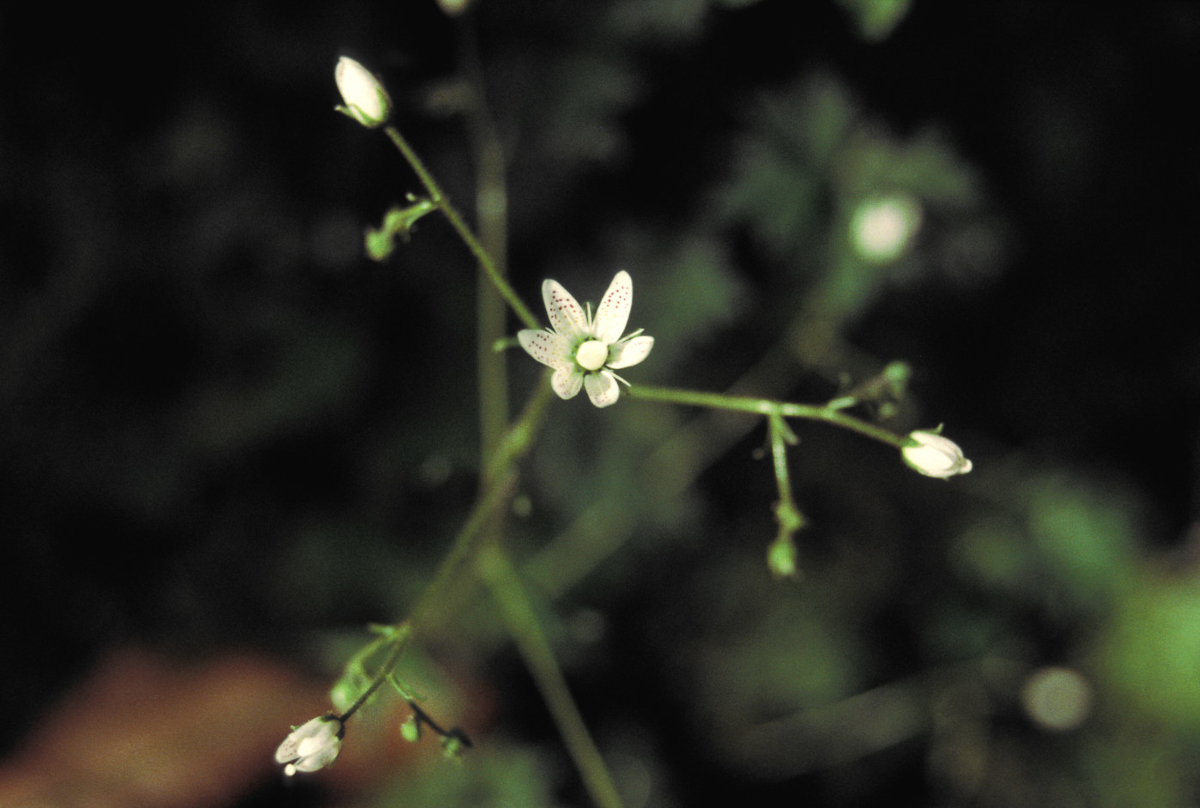


Round-leaved saxifrage
Scientific name: Saxifraga rotundifolia L.
Family: Saxifragaceae
MORPHOLOGY
Growth habit and size: Perennial herbaceous plant, with fasciculate roots and leafy stem. It grows up to 20 cm to 60 cm tall.
Stem: Leafy and hairy stem.
Leaves: Leaves form dense basal rosettes, are long-petiolate (up to 10 cm), simple, and roundish, sometimes almost heart-shaped, with coarse margins featuring numerous incisions or triangular teeth. The cauline leaves are smaller, sessile or subsessile, with a dentate to palmately trilobed blade. All leaves have a dark green upper surface with scattered hairs, while the lower surface is glabrous and lighter.
Flowers: At the apex of the flowering stems, erect, pubescent, and branched upwards, gathered in loose panicles and borne on thin peduncles; star-shaped flowers with 5 lanceolate petals, white with numerous tiny pink-violet and yellow dots; sepals are erect-patent or reflexed at fruiting, 2-3 times shorter than the petals. It blooms from June to August.
Fruits and seeds: The fruit is a pear-shaped capsule that dehisces longitudinally, releasing numerous small spindle-shaped, papillose seeds.
DISTRIBUTION AND HABITAT
It grows throughout Italy except in Sardinia, from 100 m to 2,200 m. It thrives in shady forests (typical of beech forests), rocky areas, moist stony soils, and streambanks on slopes.
USE
It is consumed as an infusion for its diuretic properties, which are believed to help dissolve and eliminate kidney stones. Before taking any plant-based product (medicinal or non-medicinal) for therapeutic or similar purposes, it is always advisable to consult a doctor.
Photos: Kindly provided by Claudio Farinati