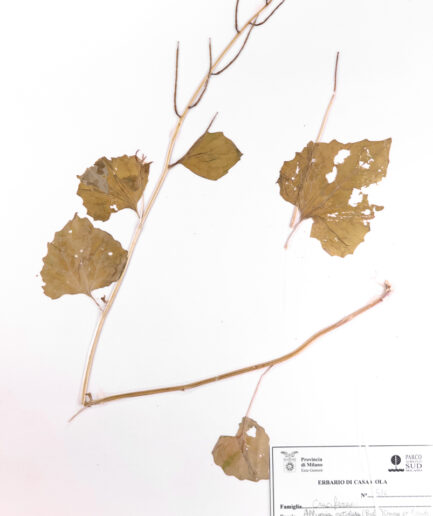



Common Buttercup
Scientific name: Ranunculus acris L.
Family: Ranunculaceae
MORPHOLOGY
Growth habit and size: A perennial herbaceous plant characterized by certain anatomical and morphological peculiarities such as the ability to germinate axillary buds. The entire plant is fundamentally glabrous and variable both in hairiness and leaf shape. The average height ranges between 30 and 80 cm.
Stem: Erect, glabrous stem, sometimes with appressed hairs only on the upper part, branched and multi-flowered. The stem is cylindrical in section and hollow inside.
Leaves: Basal leaves with a petiole of 1-4 dm and a pentagonal lamina divided into 3-7 segments; cauline leaves with shorter petioles and progressively kidney-shaped lamina; segments often completely laciniate.
Flowers: Actinomorphic perianth with a hairy calyx of 5 spreading, then deciduous sepals, greenish yellow; corolla with 5 obovate yellow petals. It blooms from January to November.
Fruits and seeds: The fruit is a 5 mm achene with a short, slightly curved beak.
DISTRIBUTION AND HABITAT
It grows throughout Italy except for the major islands, although it is occasionally found in Sardinia as a casual allochthonous plant. It grows from sea level to over 2,000 m. Common in uncultivated areas, as well as in meadows, pastures, and along paths.
USE
Folk medicine indicates these plants as purgative, emetic (useful in case of poisoning as it induces vomiting), and resolving, but it is fair to say that the remedy is worse than the ailment. Some Native American tribes use these plants as analgesics (to alleviate pain) or for external dermatological uses, as well as hemostatic (to stop bleeding in case of hemorrhage) and sedative (to calm excessive nervous or painful states). In Tibetan medicine, they are used for their ability to generate heat (warming the human body). Before taking any plant-based product (medicinal or non-medicinal) for therapeutic or similar purposes, it is always advisable to consult a doctor.
INTERESTING FACTS
These plants contain anemonin; a substance particularly toxic to animals and humans. In fact, herbivores graze on the leaves of these plants with great difficulty and only after thorough drying (haymaking) which evaporates the most dangerous substances. Even bees rarely forage on buttercups. On human skin, these plants can cause blisters (dermatitis), while on the mouth they can cause intense pain and burning of the mucous membranes.
Photo: Kindly provided by Claudio Farinati