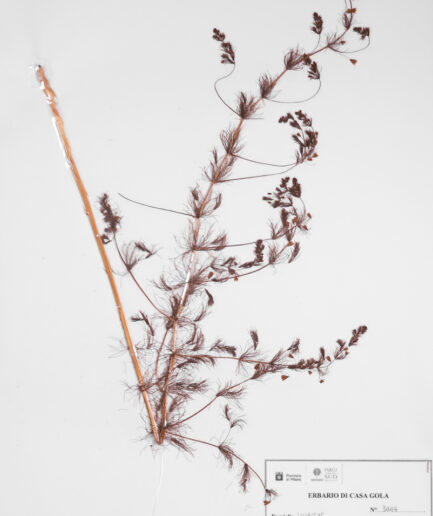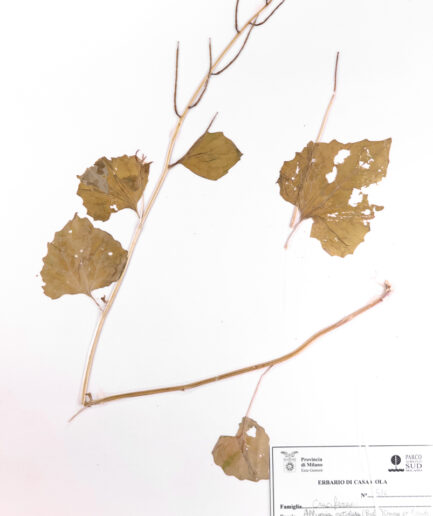



Knotgrass
Scientific Name: Polygonum aviculare L.
Family: Polygonaceae
MORPHOLOGY
Habit and dimensions: Annual, herbaceous, creeping, erect, prostrate-ascending, highly branched plant. Height 10-60 cm.
Stems: The stems, striated and glabrous, leafy up to the top, form dense tufts adhering to the ground, rarely ascending.
Leaves: Leaves with different shapes (heterophylly), especially pronounced in young plants; the leaves of the main axes are alternate, sessile or with a short petiole, lanceolate-elliptic or ovate-lanceolate, entire, glabrous or finely hairy, those of the outer branches, elliptic, but smaller with ± acute apex; reddish membranous stipules sheathing at the base of the stem.
Flowers: The flowers in groups of 2-5 at the height of the leaves, have pink or greenish perianth with 5 triangular petaloid sepals, with segments 3-4 times the length of the tube. Blooms from February to November.
Fruits and seeds: The fruits are pyriform achenes, 2-3 mm, trigonous, pointed at the apex, concave on the 3 faces.
DISTRIBUTION AND HABITAT
Present throughout Italy in anthropized, rocky areas, in trampled zones, from 0 to 1850 m.
USE
In folk medicine, due to the presence of active principles such as tannins, resins, essential oils, and bitter substances, it was used, in the form of a decoction, as a cicatrizing, astringent, for ulcers, antihemorrhagic, and diuretic because it favored the expulsion of small kidney and bladder stones. Today, it is more commonly used, for its tannin content, as an astringent and antidiarrheal. Before taking any plant-based product (medicinal or non-medicinal) for therapeutic or similar purposes, it is always advisable to consult your doctor.
INTERESTING FACTS
It is a weed of beet, cereal, and herbaceous crops in general.
Photo: under the free license of Saxifraga, Ed Stikvoort, Jan van der Straaten, Rutger Barendse, Peter Meininger