


Pokeweed
Scientific name: Phytolacca americana L.
Family name: Phytolaccaceae
MORPHOLOGY
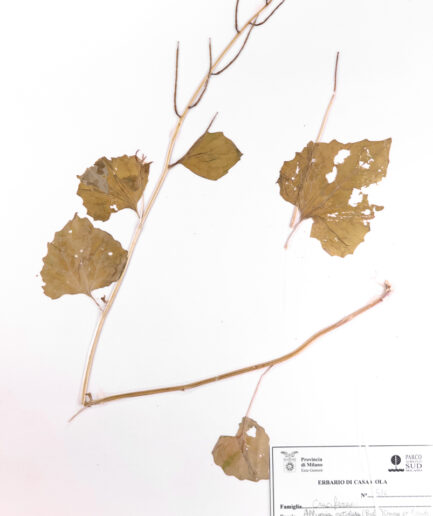
Habit and dimensions: herbaceous plant or small shrub, perennial and vigorous. It can reach up to 3 meters in height.
Stem: erect and branched, with a tetragonal section. Initially light green, turning reddish-purple as the season progresses.
Leaves: alternate, oval or lanceolate, with entire or undulating margins and acute apex. They are shortly petiolate.
Flowers: petal-less and grouped in racemes opposite the leaves. They are greenish-white, pink, or purplish.
Fruits and seeds: berries grouped in persistent clusters carried on pink peduncles. They are shiny, globose, and dark-colored, tending towards black. They contain shiny black seeds.
DISTRIBUTION AND HABITAT
Native plant of North America. Imported to Europe as a garden plant, it has become invasive and pestilent throughout the Italian territory. Found up to 400 meters above sea level, it is found in uncultivated land, fields, and along roadsides and watercourses. Prefers cool, humus-rich soils.
USE
From the berry fruits of pokeweed, a red ink and a dye were obtained, widely used in the past for dyeing wool. The roots were instead used to produce soap, as they have a high saponin content. The species has medicinal properties and was therefore used in the past for its purgative, antirheumatic, insecticidal, and anti-inflammatory properties. However, the entire plant is considered toxic. Ingestion can cause vomiting, diarrhea, drowsiness, dizziness, spasms, convulsions, and coma.
INTERESTING FACTS
Plants of the genus Phytolacca are undergoing scientific investigation to find new active principles against AIDS. Specifically, from Phytolacca americana, a protein called PAP (Poke Antiviral Protein) has been isolated, which is currently used in the medical field to inhibit the replication of the HIV virus in human cells.
The genus name derives from the Greek “phyton” (= plant) and the Indian “lakh,” a dye extracted from an insect that has a color similar to the purplish hue of pokeweed berries.
The species is also called pokeberry.
Photo: under a free license from INaturalist