


Galingale
Scientific Name: Cyperus longus L.
Family: Cyperaceae
MORPHOLOGY
Habit and Size: Perennial plant, reaching over one meter in height. It has a creeping, horizontal, thick rhizome without tubers.
Stems: Erect, robust stem, sharply trigonous, with the base wrapped for about 20 cm by yellowed leaves reduced to the sheath only.
Leaves: Leaves with a flat blade of 5-6 mm, soon disappearing. Bracts usually 3-4, linear, longer than the inflorescence (7-17 cm).
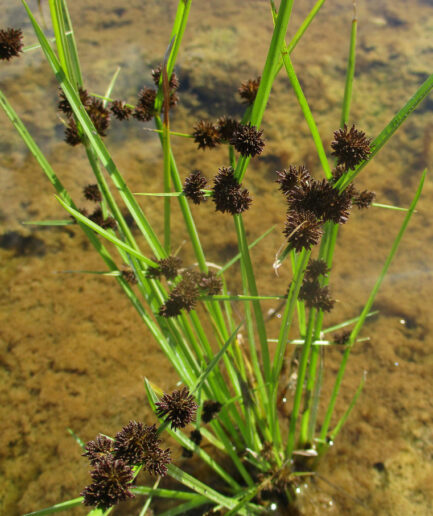
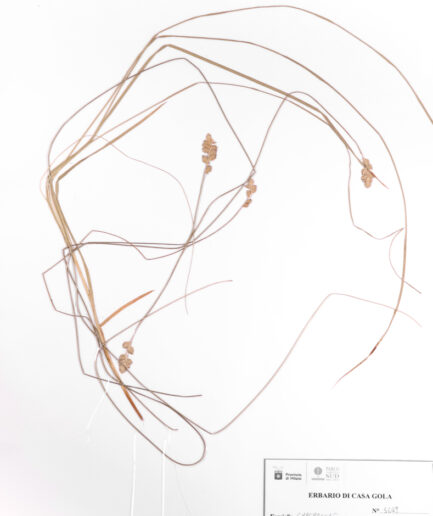
Flowers: Umbelliform inflorescence with few branches (3-10) of unequal length. Some branches are partially undivided, 3-6 cm long, and directly bear a cluster of spikes, while others are formed by a common peduncle of 8-12 cm divided into 3-5 shorter second-order peduncles carrying the spikes. These spikes are linear, distichous on opposite sides of a common axis, up to 1 cm long, with 15-25 flowers, brownish-red, sometimes slightly falcate, borne on simple or branched peduncles of 3-20 cm. Blooms from May to September.
Fruits and Seeds: Triangular-ellipsoidal achene.
DISTRIBUTION AND HABITAT
Present throughout Italy, it grows in ditches, stagnant waters, riverbanks, from sea level up to 1300 m.
USE
The rhizome of the plant was used as a tonic and stimulant, and was considered a good digestive and useful in cases of dropsy. Before taking any plant-based product (medicinal or non-medicinal) for therapeutic or similar purposes, it is always advisable to consult your doctor.
INTERESTING FACT
The root is used as a spice in soups, pies, and desserts, while the leaves are used in weaving crafts.
Photo: Under a free license by Saxifraga and Rutger Barendse.