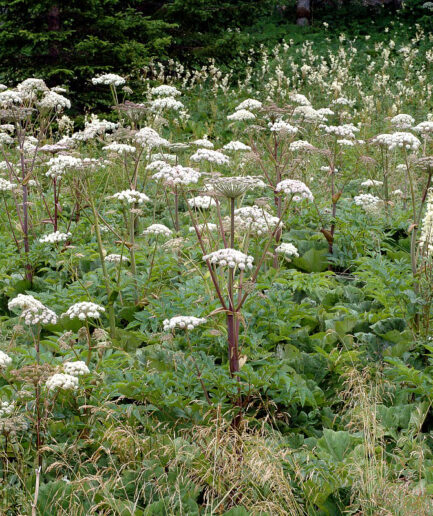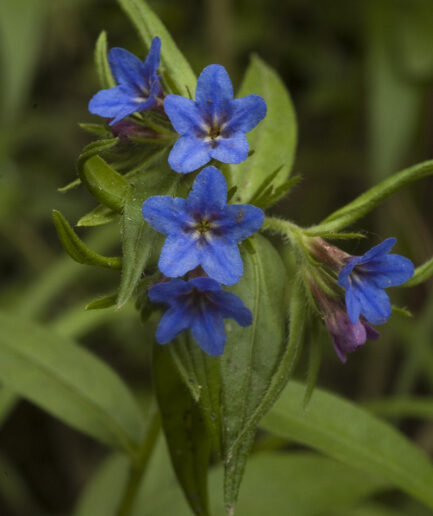



Dame’s violet
Scientific name: Hesperis matronalis L.
Family: Brassicaceae
MORPHOLOGY
Habit and dimensions: Herbaceous perennial or biennial plant, more or less pubescent, ranging from 50 to 90 cm in height.
Stem: Erect, cylindrical stem, branching upwards.
Leaves: Basal leaves alternate, slightly hairy, petiolate, dentate or lyrate margin (1 – 2 x 8 – 16 cm) with very small sessile glands; cauline leaves gradually smaller, lanceolate with semi-amplexicaul subnate petiole and serrated margin.
Flowers: Fragrant flowers borne on sub-corymbose racemes, initially very dense and elongated after anthesis. Calyx with 4 glabrous sepals, connivent and just shorter than the petal claw. Petals 4 cruciform, spatulate, pink-violet in color, sometimes white, with an oval and spreading limb of about 1 cm. Blooms from April to July.
Fruits and seeds: The fruit is a glabrous or slightly hairy cylindrical silique that opens at maturity into 2 valves with 2 rows of seeds.
DISTRIBUTION AND HABITAT
Naturalized allochthonous species present throughout Italy except for the major islands and Apulia in humid woods, ravines, roadsides on hills from 0 to 1,200 m.
USE
The infusion of the leaves has stimulating, antidiarrheal, sudorific, diuretic, and expectorant properties. Fresh leaves are rubefacient. The seeds contain a high percentage of oil, which, however, tastes bitter and acrid. It freezes at the same temperature as olive oil. The plant juice can be consumed, although it tastes bitter, mixed in milk, or with wine “after macerating the leaves in it”. A poultice made with the leaves brings abscesses to maturity. Before taking any plant-based product (medicinal or non-medicinal) for therapeutic or similar purposes, it is always advisable to consult your doctor.
INTERESTING FACTS
It was introduced to Europe from Asia Minor in the Viennese gardens and was called “viola damascena” or “Syrian violet”. In Italy, it arrived through France and was called “viola matronale” (matron violet). Botanists, reluctant to be influenced by ephemeral trends, continued to call it by the ancient name “hesperide”.
Photo: under a free license by Saxifraga, Peter Meininger, Jan van der Straaten, Rutger Barendse