


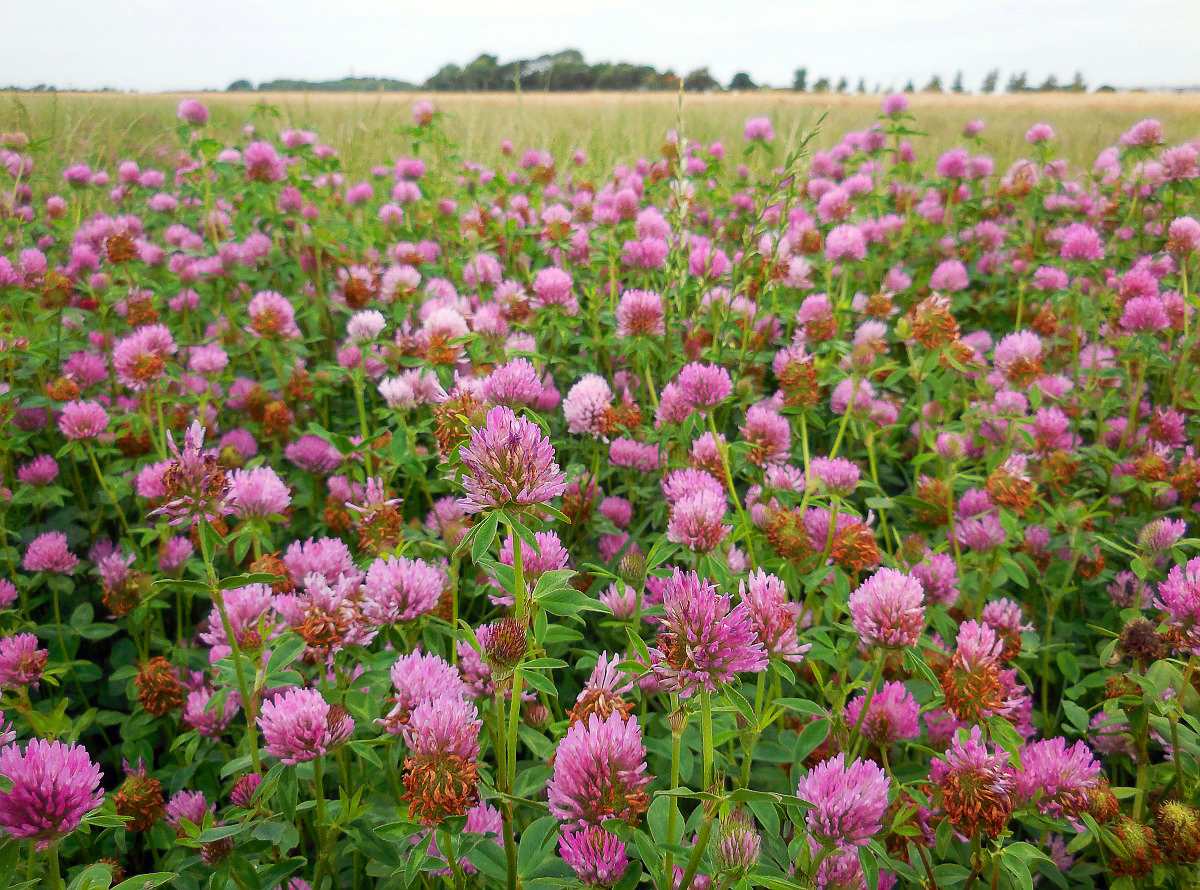
Red Clover
Scientific name: Trifolium pratense L.
Family: Fabaceae
MORPHOLOGY
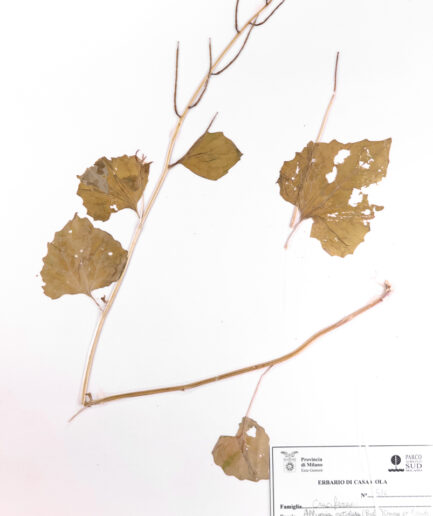
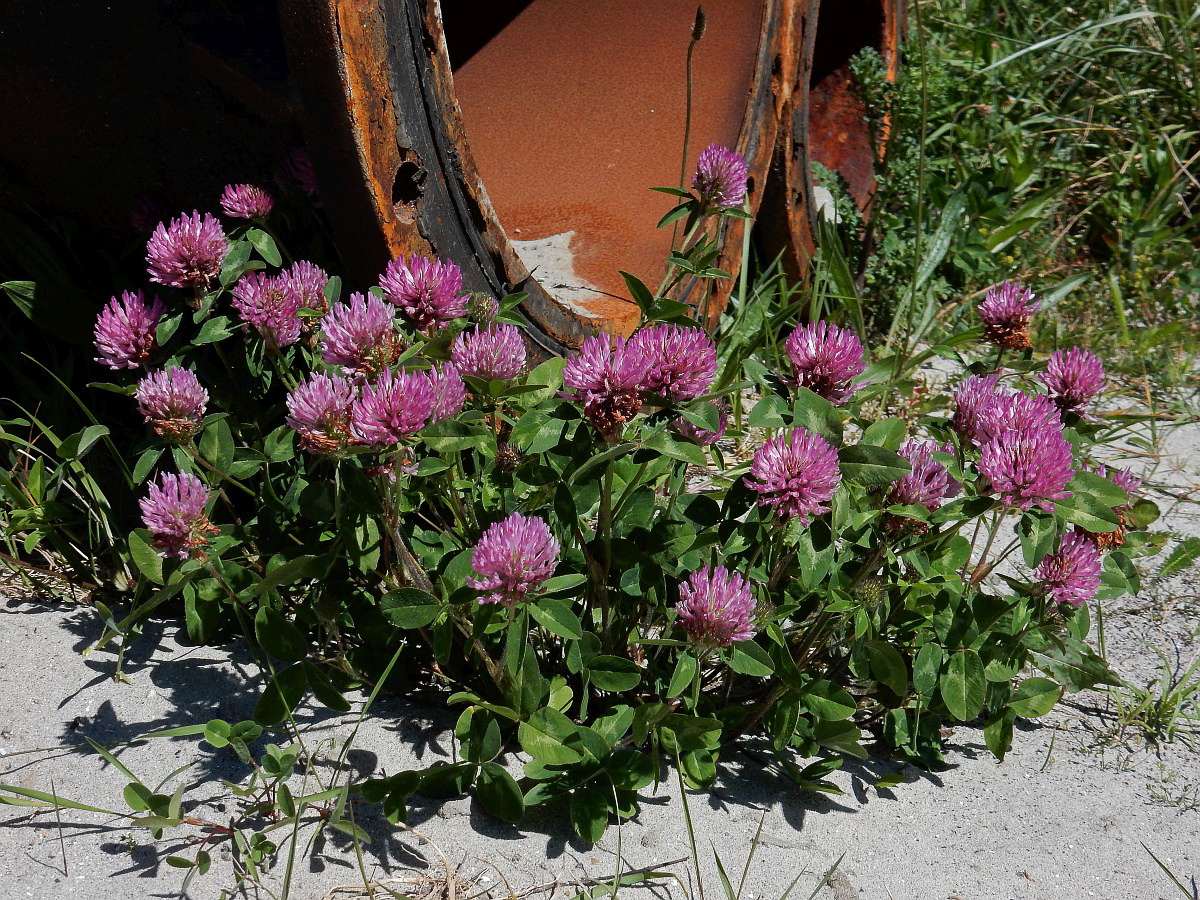
Habit and Size: Perennial herbaceous plant, although its longevity is limited, generally not exceeding two years; woody rhizome wrapped in dark sheaths, with numerous small tubercles on the lateral branches capable of fixing atmospheric nitrogen. Height between 10 and 60 cm.
Stem: Erect stems, briefly creeping, simple.
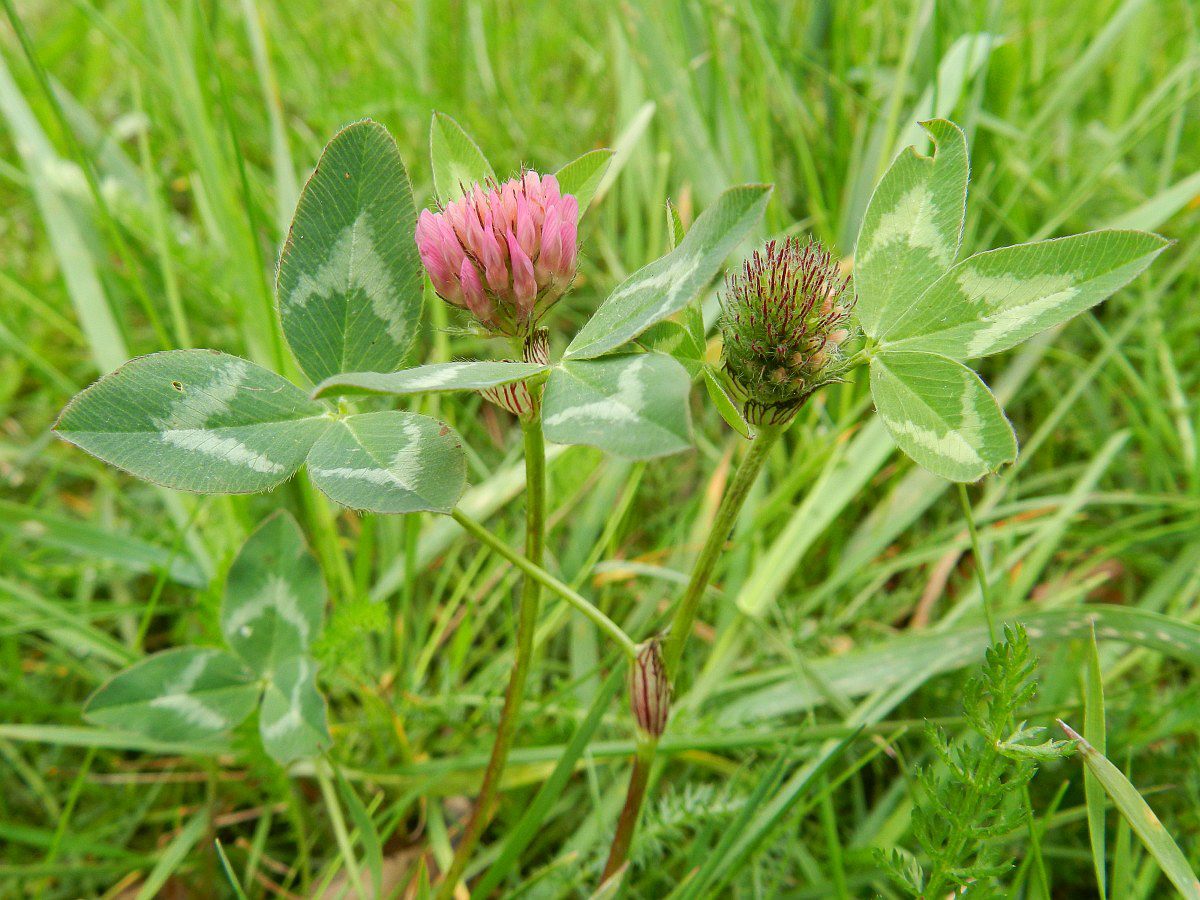
Leaves: Long-petioled leaves, trifoliate, oval or elliptical, with elongated stipules ending in a bristle, the upper surface characterized by a whitish “V”-shaped pattern.
Flowers: Flowers in globular heads, pedunculate or subsessile, at the axils of the upper leaves, light red, carmine, or milky. Blooms year-round.
Fruits and Seeds: Fruits are legumes, called camaras, indehiscent, enclosed in the calyx, with a membranous pericarp and a single ovoid seed, smooth, yellowish or brown.
DISTRIBUTION AND HABITAT
Present throughout Italy in meadows, pastures, and uncultivated lands, from 0 to 2,600 m.
USE
Sweet herb, refreshing, antispasmodic, expectorant, cleansing, diuretic. Dioscorides and Galen attributed to it the property of healing wounds caused by venomous snake bites. In the past, it was used as a febrifuge, tonic, diuretic, menstrual stimulant, expectorant, antispasmodic, anti-inflammatory, glandular secretion regulator, and anti-eczema. Useful for treating coughs, bronchitis, infections, and as a blood purifier; in India, it is used to promote lactation in nursing mothers and as a uterine tonic to help the uterus recover after childbirth. Before taking any herbal product (whether medicinal or non-medicinal) for therapeutic or similar purposes, it is always advisable to consult your doctor.
Red Clover has long been one of the most widespread forage legumes in Europe and in some countries of the old continent, it covers several hundred thousand hectares. In Italy, however, pure cultivation of this meadow legume has progressively lost interest over the past twenty years. Consumed as green fodder, rarely as hay, due to the loss of leaves that crumble upon drying, it is so highly appreciated by livestock that it has earned the name “bread of milk.”
Besides being an important forage plant, Red Clover is used in crop rotation to enrich the soil as clover plants have small nodules on their roots containing bacteria capable of transforming abundant atmospheric nitrogen, which plants do not absorb directly, into organic ammonium essential for their growth. Trifolium pratense is an important honey plant, in some places the only source of nectar and pollen for bees in the summer months, although its most loyal pollinators seem to be bumblebees.
INTERESTING FACTS
Clover has always been used as a decorative motif; in Gothic art, its leaves were depicted as a symbol of the Trinity.
Greek and Roman traditions attributed to the plant the power to heal snake and scorpion bites, always representations of the devil.
Venerated by the Druids, chosen as a symbol of the Trinity and Salvation in Christian iconography, in Europe it became a sign of luck and prosperity.
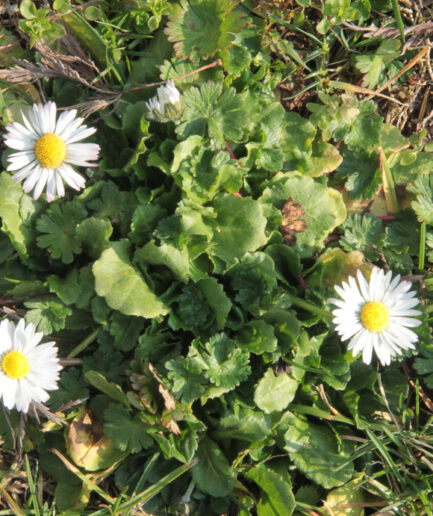
On St. John’s Day in France, young girls used to look for clover flowers as a confirmation of love, much like with daisies.
In medieval herbals, the plant was assigned the therapeutic virtue of curing eye spots (leucomas), simply by placing clover leaf powder on them. Within fifteen days, one was sure of recovery, as it could still be read, “probatum est.”
Legend has it that Patrick, the first to bring the word of Christ to Ireland, managed to illustrate the mystery of the Trinity using the comparison with the clover. When Patrick was proclaimed a saint, he began to be represented with a clover in his hand or embroidered on his episcopal vestments.
During the English domination, George III, seeking to secure the collaboration of the Irish nobility, instituted in 1783 the Order of St. Patrick, in whose emblem the clover prominently featured. Thus, associated with the figure of St. Patrick, the clover became one of the symbols of Ireland, so much so that on March 17, the feast of the saint and the nation, some Irish people still traditionally wear one or more sprigs of clover on their clothing.
Not of ancient cultivation, red clover probably arrived in Europe through Spain and from there spread to France, Germany, and the Netherlands.
Already known as a forage plant, Red Clover was never extensively cultivated until, introduced in England around the mid-1600s, it was incorporated into crop rotation as a replacement for bare fallow. The consequences of this measure were twofold: on the one hand, it caused a significant increase in forage availability, and on the other, thanks to its nitrogen-fixing ability and the consequent increase in soil nitrogen content, it allowed an increase in overall agricultural production.
Photos: freely licensed from Saxifraga and Ed Stikvoort, Rutger Barendse