


Rice
Scientific Name: Oryza sativa L.
Family: Poaceae
MORPHOLOGY
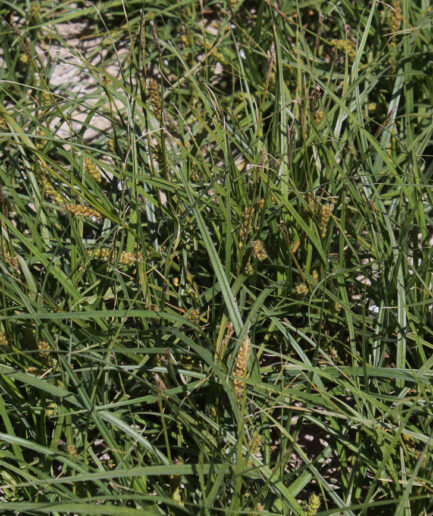
Habit and size: Annual herbaceous plant, up to 1.5 m tall (can reach up to 5 meters) with adventitious and embryonic roots, which have the characteristic of developing aerenchyma, allowing rice to live in aquatic environments.
Stem: The erect stem (culm), consisting of solid thickened nodes spaced by more or less long hollow internodes, develops similarly to wheat.
Leaves: Alternate leaves, equal in number to the internodes, with a blade ranging in color from green to reddish-purple with an elongated cylindrical sheath that partially encloses the upper internode before detaching sharply at an angle. At the angle junction between the blade and the sheath is a bifid ligule, normally hyaline, and two auricles or small hairy ear-like appendages. The blade is 30-50 cm long and 1.5 cm or slightly wider with parallel veins and a well-defined midrib.
Flowers: Terminal inflorescence at the top of the culm in a racemose panicle, pendulous at maturity, consisting of oval spikelets with hermaphrodite flowers, laterally compressed, awned or awnless. Blooms from June to September.
Fruits and seeds: The fruit is an ellipsoid or spherical caryopsis consisting of a single-seeded dry indehiscent fruit covered by two hardened glumes (husk) commonly called “rice grain.”
DISTRIBUTION AND HABITAT
Invasive allochthonous species present in Sardinia and from Tuscany upwards in the regions where rice is cultivated. It lives in rice paddies mixed with cultivated varieties and in flooded fields, between 0 and 400 m, exceptionally up to 1,900 m.
INTERESTING FACTS
Compared to cultivated varieties, it has the characteristic of dropping its seeds as soon as they mature, thus reproducing rapidly. The technique used to control it is called “false sowing,” which involves preparing the soil as if it were to be seeded and managing it as if it were sown until the weeds germinate. At this point, they are mechanically or chemically removed, and normal tillage and sowing are carried out. The cultivation of rice was initiated, according to ancient Chinese texts, by the mythical and long-lived Emperor Chin-Nong (3330 to 3080 B.C.), who personally scattered rice seeds. However, it is doubtful whether it was actually initiated in China or rather in the Indo-Chinese area. However, rice has been a staple food for Indian, Indo-Chinese, Indonesian, and Japanese peoples since ancient times. The results of recent archaeological research (1973-1986) have shown that rice cultivation was practiced in the lower Yangtze basin already 5000 or 6000 years ago, recovering some necrotized rice plant specimens, as well as at Pengloushan where raw rice grains were found in bowls dating back to 8200-7800 B.C. The Greeks became acquainted with rice mainly after Alexander’s campaigns in India, and apparently, this plant was already cultivated in Mesopotamia at the beginning of the Common Era. In Italy, cultivation was introduced at the end of the Middle Ages, probably through the Arabs (although rice was already known and highly valued by the ancient Romans); the first crops, started around Pavia, were very profitable and kept as a monopoly of the Milanese grand ducal family (Visconti and then Sforza), minor crops were already present in the fifteenth century near Lucca and in Pisa. Today, the intensive cultivation area extends from Pavia to Vercelli and Chivasso. Rice paddies have either a permanent character (i.e., they are used only for rice cultivation, remaining flooded for most of the year) or the same area is first used for early ripening wheat, harvested in the second half of June, then submerged, and in early July, rice seedlings are transplanted, which produce a second harvest by October. Rice paddies do not represent just any cultivation environment, but rather an ecological niche of great naturalistic interest, which reproduces in our country characteristic aspects of tropical and subtropical countries: exotic adventitious species abound (Rotala ramosior (L.) Koehne, Ammania auriculata Willd. and A. coccinea Rottb., Murdannia keisak (Hassk.) Hand.-Mazz., Commelina communis L., Eclipta prostrata (L.) L., Lindernia dubia (L.) Pennell, Blyxa japonica (Miq.) Maxim., Ottelia alismoides (L.) Pers., Heteranthera rotundufolia (Kunth) Griseb., etc.) and some algae (Idrodictyon reticulatum, Spaeroplea annulina, Spirogyra sp., Chara foetida).
Photo: Licensed under CC BY-SA 3.0 by iNaturalist