
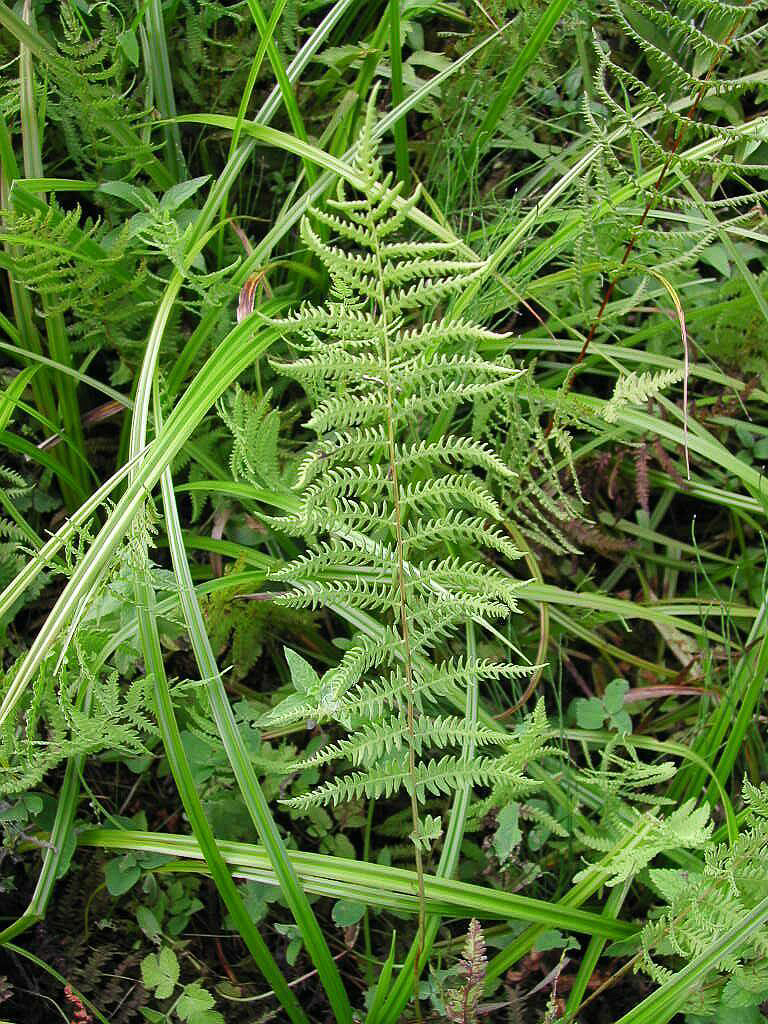


Marsh fern
Scientific name: Thelypteris palustris Schott
Family name: Thelypteridaceae
MORPHOLOGY
Habit and dimensions: a pteridophyte with a creeping rhizome. From here, the fronds arise in alignment, appearing erect or slightly drooping, reaching a height between 30 and 80 centimeters.
Stem: underground stem, called rhizome, which emits roots and adventitious stems every year.
Leaves: fertile fronds are narrower than sterile ones, larger and leathery. They have lanceolate or narrowly ovate blades and entire pinnules with revolute margins.
Flowers: as ferns are not angiosperms, they do not produce flowers.
Fruits and seeds: unlike angiosperms and gymnosperms, ferns do not have seeds but spread in the environment through spores. In marsh ferns, ellipsoid spores are carried by blackish, dense sori equidistant from the margin and central vein.
DISTRIBUTION AND HABITAT
Hygroacidophilic fern present in almost all Italian regions. It grows up to 1,400 meters above sea level, preferring wet areas, bogs, and riverbanks. They form distant stations from each other, leading to difficulties in genetic exchange.
In recent years, the species has been threatened by the reduction of marshy habitats due to reclamation projects.
USE
The plant is used for ornamental purposes, even for indoor environments. There are several varieties available commercially, differing in the color of the fronds or habit. Marsh fern can be considered for certain types of reclamation projects: it has been demonstrated that the species can tolerate and absorb arsenic present in the soil.
INTERESTING FACTS
The genus name derives from the Greek “thély” (= female) and “ptéris” (= fern), referring to its more delicate appearance compared to other ferns, while the species epithet derives from “pàlus” (= marsh), referring to its preferred habitat.
Photo: Used under a free license by Saxifraga – Branko Bakan and Jasenka Topic