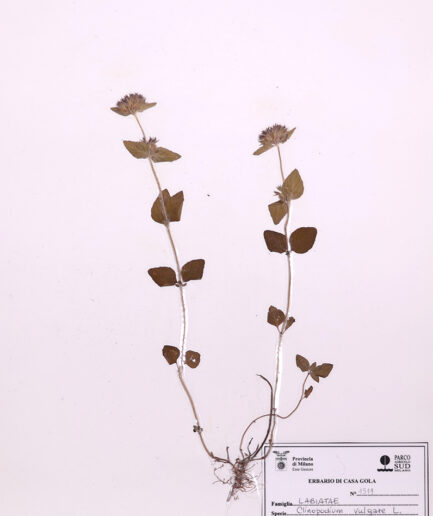



Spotted Dead-nettle
Scientific name: Lamium maculatum L.
Family: Lamiaceae
MORPHOLOGY
Growth habit and size: Perennial herbaceous plant. Height 20÷50 cm.
Stem: Erect or prostrate-ascending, subglabrous stems with a quadrangular section, sometimes rooting at the nodes.
Leaves: Opposite leaves, mainly located in the lower part of the stem, petiolate, lanceolate ovate-cordate, with a pubescent, dentate lamina, generally characterized by an elongated spot along the midrib, colored silvery or whitish.
Flowers: Mauve-colored flowers, sometimes white, arranged in terminal spike-like inflorescences of 4-8 elements. The calyx is 5-6 mm long and hairy; the corolla has a thin tube longer than the calyx, with a concave and curved upper lip and a bilobed obcordate lower lip with a fringed margin. The upper lip is mauve, while the lower lip has a prominent purple spot on a nearly whitish background. Blooms from February to December.
Fruits and seeds: The fruits are 4 small obovoid, trigonal, chestnut-colored mericarps (nutlets or achenes).
DISTRIBUTION AND HABITAT
It grows throughout Italy except in Sicily. It prefers fields, grassy areas, disturbed woodland edges, dumps, ruins, gardens, and cultivated areas in shaded regions, forming dense mats as a ground cover. It grows from sea level up to 2,000 m.
USE
In medicine, the flowering tops are used in infusions to treat seborrhea and skin infections. Before taking any plant-based product (medicinal or non-medicinal) for therapeutic or similar purposes, it is always advisable to consult a doctor. In popular cuisine, the leafy tops are consumed boiled.
Photo: Kindly provided by Claudio Farinati