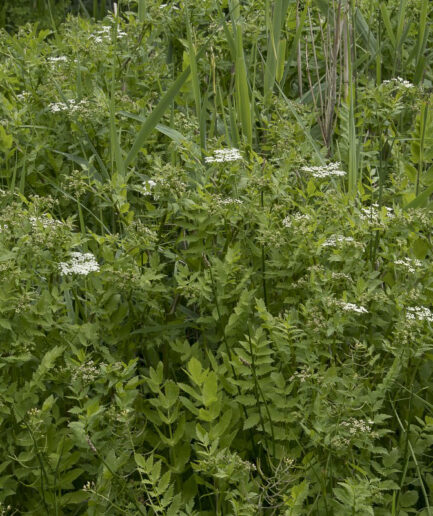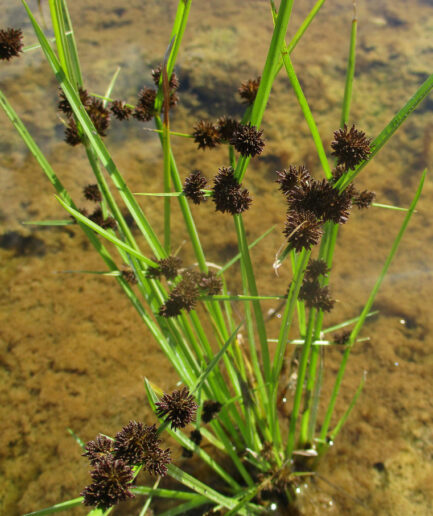



Water Hemlock
Scientific Name: Eupatorium cannabinum L.
Family: Asteraceae
MORPHOLOGY
Growth habit and size: Perennial herbaceous plant, reaching heights of 60-150/200 cm, covered with short, fairly crinkled short hairs, with a fibrous white-grayish root.
Stem: Erect, longitudinally grooved, often reddish, branched-corymbose in the upper part.
Leaves: Opposite or alternate leaves, shortly petiolate, the lower ones lanceolate-acuminate, the upper ones divided into 3 lanceolate segments with an acute apex, all with irregularly serrated-dentate margins.
Flowers: Inflorescence in capitula grouped in dense, flattened corymbs at the apex of the main stems. Each capitulum consists of 5-6 florets with 5 dentate lobes, all equal, tubular, without ligules, hermaphroditic, slightly fragrant, dusty pink, sometimes whitish, 10 mm long. They are surrounded by a cylindrical involucre with imbricate scales, the outer ones being obtuse and very short. Long white stylus. Blooms from June to September.
Fruits and seeds: Angular-striated achenes borne by a pappus with a single series of stiff, whitish hairs.
DISTRIBUTION AND HABITAT
It grows throughout Italy. It prefers humid places, cool woods, riverbanks and beds, marshy areas, but also fallow and ruderal soils, from sea level up to 1,400 m.
USE
The pant contains numerous active principles: eupatoriopicrin is anticarcinogenic and inhibits cell growth, polysaccharides act on the immune system, and p-cymene, an essential oil, possesses antiviral properties that make the body more resistant to viral infections. This plant has long been known and used for its cholagogue-choleretic (to alleviate liver disorders), diuretic, depurative, laxative, and expectorant properties to combat colds and flu fevers. The active principles contained in the root act as laxatives and vermifuges, while those in the leaves and flowering tops have diuretic, diaphoretic, depurative, and cholagogue effects. Decoctions of eupatorium were used to promote the healing of wounds, skin ulcers, eruptions, eczema, and skin cracks. However, it has a high content of hepatotoxic alkaloids; therefore, the use of this plant is not recommended or should be taken under strict medical supervision. It is always advisable to consult a doctor before consuming any plant-based product (medicinal or non-medicinal) for therapeutic or similar purposes.
Photo: Kindly provided by Claudio Farinati