


Wild Angelica
Scientific name: Angelica sylvestris L.
Family: Apiaceae
MORPHOLOGY
Growth habit and size: Perennial herbaceous plant, with a light brown root containing a yellow juice with an aromatic-pungent odor. A polymorphic species of considerable size, reaching up to 2 m in height.
Stem: Stout, erect, cylindrical, striated, branched at the top, covered with white bloom and suffused with purple; finely pubescent under the inflorescences.
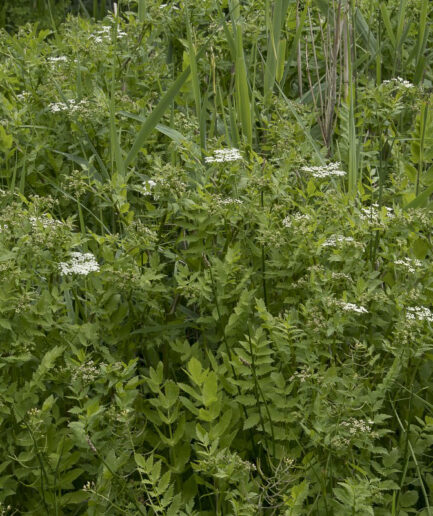
Leaves: The basal leaves, which can reach up to 60 cm in length, have a glabrous leaf stalk shaped like an eavestrough, hollow inside, with a tripinnate blade divided into ovate-lanceolate segments. The margin has sharp teeth ending in whitish cartilaginous spines. The cauline leaves have swollen sheaths that envelop and protect the young axillary branches and the inflorescences still in bud. The upper leaves are less divided, those at the apex are almost sessile, and the petiole is reduced to a sheath.
Flowers: Hermaphroditic, very small, with 5 white or pinkish petals, arranged in dense umbels, which in turn are grouped in large compound umbels with 30-50 rays, generally pubescent. Blooms from May to August.
Fruits and seeds: The fruits are flattened, elliptical diachenes, with 2 membranous wings as wide as the seed and 3 prominent ribs.
DISTRIBUTION AND HABITAT
Widespread throughout Italy, it grows in shady and humid places, woods, hedges, along riverbanks, and in peat bogs, at altitudes between 0 and 1,600 m.
USES
It has digestive, aperitive, carminative, tonic, diuretic, and expectorant properties; it is recommended for coughs and digestive problems. Used in the preparation of eupeptic bitters with a direct mechanism acting on the gastric glands. The powder obtained by grinding the seeds is effective against lice. Before taking any plant-based product (medicinal or non-medicinal) for therapeutic or similar purposes, it is always advisable to consult a doctor. The leaves and tender stems can be consumed as vegetables. Raw leaves can be added to mixed salads, sauces, and fillings. In pastry, the petioles and sprouts are used in the preparation of candied fruits. A yellow dye can be obtained from the root.
INTERESTING FACTS
The sheaths of the cauline leaves retain small amounts of rainwater that can host tiny aquatic organisms. The small flowers are nectariferous and visited by bees, dipterans, lepidopterans, coleopterans, and various species of hymenopterans. Honey with a prevalence of umbellifers may have an odor and flavor that is not always pleasant, reminiscent of the plant of origin. All Angelica species contain furocoumarins, which increase skin photosensitivity and can cause dermatitis.
Photo: Under the free license of Saxifraga and Jan van der Straaten, Rutger Barendse